A machine learning compiler for GPUs, CPUs, and ML accelerators
4.4k
Stars
859
Forks
855
Open issues
30
Contributors





AI Analysis
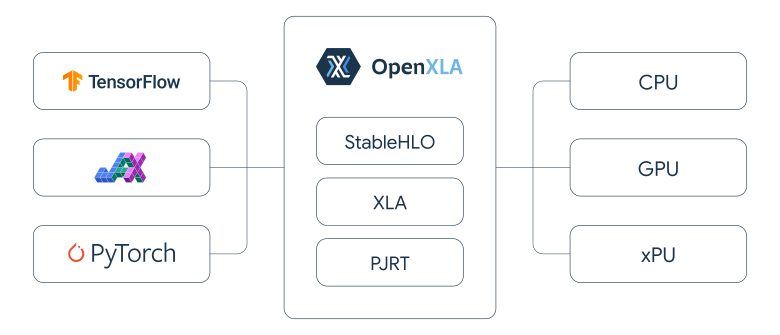
XLA is an open-source machine learning compiler that optimizes models from PyTorch, TensorFlow, and JAX for high-performance execution across GPUs, CPUs, and ML accelerators. It is specifically designed for ML framework integrators and compiler contributors rather than end users, who interact with XLA indirectly through their chosen framework. This project is most valuable for researchers, ML platform engineers, and hardware vendors seeking to optimize tensor computations across diverse hardw...
Inferred from signals mentioned in the README (tests, CI, type safety) — not a review of the actual code.
AI's overall editorial judgment — not an average of the bars above, can weigh other factors too.
ML compiler for PyTorch, TensorFlow, JAX targeting GPUs and accelerators
XLA is an open-source compiler that optimizes machine learning models from major frameworks (PyTorch, TensorFlow, JAX) for execution on GPUs, CPUs, and custom ML accelerators. It is maintained by Google and used indirectly by millions through framework integrations rather than direct adoption. The project solves the hard problem of cross-hardware compilation and performance portability for ML workloads.
XLA originated within Google's ML infrastructure and was publicly released as part of TensorFlow. The openxla.org organization was established in 2022 as a formal, framework-agnostic home for the compiler, separating it from TensorFlow's direct governance to serve PyTorch, JAX, and other frameworks.
XLA gained adoption primarily through deep integration with PyTorch (pytorch/xla) and TensorFlow's backend, rather than direct end-user cloning. The 2022 reorganization under OpenXLA signaled maturity and broader framework support. Growth is measured by compiler quality and framework adoption rather than GitHub stars, which remain modest at 4,356.
XLA sees production use indirectly through PyTorch/XLA and TensorFlow integrations. pytorch/xla (2,788 stars) has larger adoption signal. However, direct adoption metrics for openxla/xla repository are limited in README. Adoption through framework integrations is verified; adoption of the standalone repository for development is not clearly quantified.
Based on README, XLA is a compiler pipeline taking high-level ML operations and lowering them to hardware-specific code. It appears to support multiple frontends (PyTorch, TensorFlow, JAX) and backends (GPU, CPU, ML accelerators). Implementation details not inspectable from README alone.
Not documented in README. README directs contributors to developer guide but does not describe test infrastructure or coverage metrics.
Last push 2026-07-01 (current date), indicating active maintenance. 850 forks and sustained engagement suggest ongoing development. Growth rate of 8 stars in 7 days is modest but consistent with a mature infrastructure project rather than a rapidly trending tool. The project appears actively maintained rather than stagnant.
ADOPT IF: you need cross-platform ML compilation for GPU/CPU/accelerator deployment and are already using PyTorch, TensorFlow, or JAX—integration through those frameworks handles most complexity. AVOID IF: you require a standalone, framework-agnostic compiler with minimal framework overhead or need enterprise SLA support outside Google's stewardship. MONITOR IF: you are building a new ML framework and need a proven, open-source compilation backend; XLA is mature but integration effort is substantial.
Independent dimensions
Mainstream potential
4/10
Technical importance
8/10
Adoption evidence
6/10
- Heavy Google stewardship: project direction and priorities may reflect Google's internal ML infrastructure needs rather than broader community consensus.
- Integration complexity: intended for framework developers and compiler contributors, not end users. Adoption barriers are high for new hardware backends or custom optimization passes.
- Competitive pressure from framework-specific compilers (e.g., NVIDIA Triton for tensor optimization) that may offer better single-platform performance for narrow use cases.
- Limited evidence of independent commercial adoption outside PyTorch/TensorFlow/JAX ecosystems; success is indirect and hard to measure.
- Maintenance concentration: small visible contributor base relative to project's scope; bus factor risk if Google's involvement declines.
XLA will remain a critical, stable backend for multi-framework ML compilation rather than becoming a widely adopted standalone tool. Adoption will likely grow through deeper framework integration and hardware vendor support (custom accelerators) rather than through direct user downloads.
Explore similar
Newsletter
Get analyses like this every Monday
Free weekly digest of the most interesting open-source discoveries.
Languages
Information
- Language
- C++
- License
- Apache-2.0
- Last updated
- 7h ago
- Created
- 48mo ago
- Analyzed with
- anthropic/claude-haiku-4-5
Stars over time
Contributors over time
Top 100 contributors only — repos with more will plateau at 100.
Open issues
No open issues — clean slate.
Top contributors
Recent releases
No releases published yet.
Similar repos
| Repository | Stars | Week Δ | Language | Score | Updated |
|---|---|---|---|---|---|
|
openxla/xla
this
|
4.4k | +9 | C++ | 8/10 | 7h ago |
 pytorch/xla pytorch/xla
|
2.8k | — | C++ | 7/10 | 1mo ago |
 gomlx/gomlx gomlx/gomlx
|
1.5k | — | Go | 8/10 | 1d ago |
 google/xls google/xls
|
1.5k | — | C++ | 7/10 | 10h ago |
 xLLM-AI/xllm xLLM-AI/xllm
|
1.5k | — | C++ | 7/10 | 10h ago |
 apple/axlearn apple/axlearn
|
2.4k | — | Python | 8/10 | 2d ago |
PyTorch-specific XLA bindings with higher star count (2,788 vs 4,356 for core). pytorch/xla is the practical entry point for PyTorch users; openxla/xla is the shared compiler foundation.
XLA also integrated into TensorFlow's native backend. No separate repository; adoption happens through TensorFlow's version lifecycle.
Higher star count (27,375) but different scope—MLX targets Apple Silicon specifically. XLA pursues hardware-agnostic ML compilation; MLX pursues optimized single-platform experience.
Hardware synthesis compiler; different problem domain (circuit design vs ML execution). No direct competition.
Go bindings for XLA (1,471 stars). Demonstrates XLA's use as a backend for language-specific ML libraries rather than as standalone adoption.