NVIDIA Cosmos is an open platform of world models, datasets, and tools that enables developers to build Physical AI for robots, autonomous vehicles, smart infrastructure, and more.
11k
Stars
760
Forks
40
Open issues
24
Contributors


AI Analysis
NVIDIA Cosmos is an open platform of omnimodal world models that process and generate language, images, video, audio, and action sequences for Physical AI applications. It serves developers building embodied AI systems for robotics, autonomous vehicles, and smart infrastructure—not a general-purpose model, but a specialized toolkit for multimodal simulation and reasoning in physical domains.
Inferred from signals mentioned in the README (tests, CI, type safety) — not a review of the actual code.
AI's overall editorial judgment — not an average of the bars above, can weigh other factors too.
NVIDIA Cosmos 3 opens omnimodal world-model platform for Physical AI development
NVIDIA Cosmos is an open platform providing world models, datasets, and tooling for Physical AI applications — robotics, autonomous vehicles, and smart infrastructure. Cosmos 3, the current release, is a 16B–64B parameter omnimodal model family that jointly processes and generates language, images, video, audio, and action sequences within a unified Mixture-of-Transformers architecture. It targets AI researchers, robotics engineers, and AV developers who need simulation-quality world models for synthetic data generation, policy learning, and embodied reasoning. Backed by NVIDIA's hardware and serving stack (NIM, vLLM), it sits at the intersection of foundation model research and applied Physical AI engineering.
Repository created December 2024 alongside a public NVIDIA announcement. Cosmos 3 represents a significant evolution from earlier Cosmos 1/2 releases, expanding from video generation toward fully omnimodal generation and reasoning within a single architecture.
The project launched with strong initial momentum driven by NVIDIA's brand and the novelty of open-sourcing large world models. Growth has since stabilized at ~10.6k stars with near-zero star velocity in the last 7 days, suggesting the initial wave of attention has plateaued. Ongoing activity is sustained by NVIDIA's internal roadmap rather than organic community expansion, with the last push occurring on the current date (2026-06-27), indicating continuous internal development.
NVIDIA provides NIM (NVIDIA Inference Microservices) integration and references vLLM-Omni for OpenAI-compatible serving, suggesting production deployment paths exist within NVIDIA's enterprise ecosystem. Policy models fine-tuned on DROID and other robotics datasets are listed, implying some internal or partner validation. However, independent third-party production deployments are not publicly documented in the README. Adoption outside NVIDIA and its direct partners is not verified.
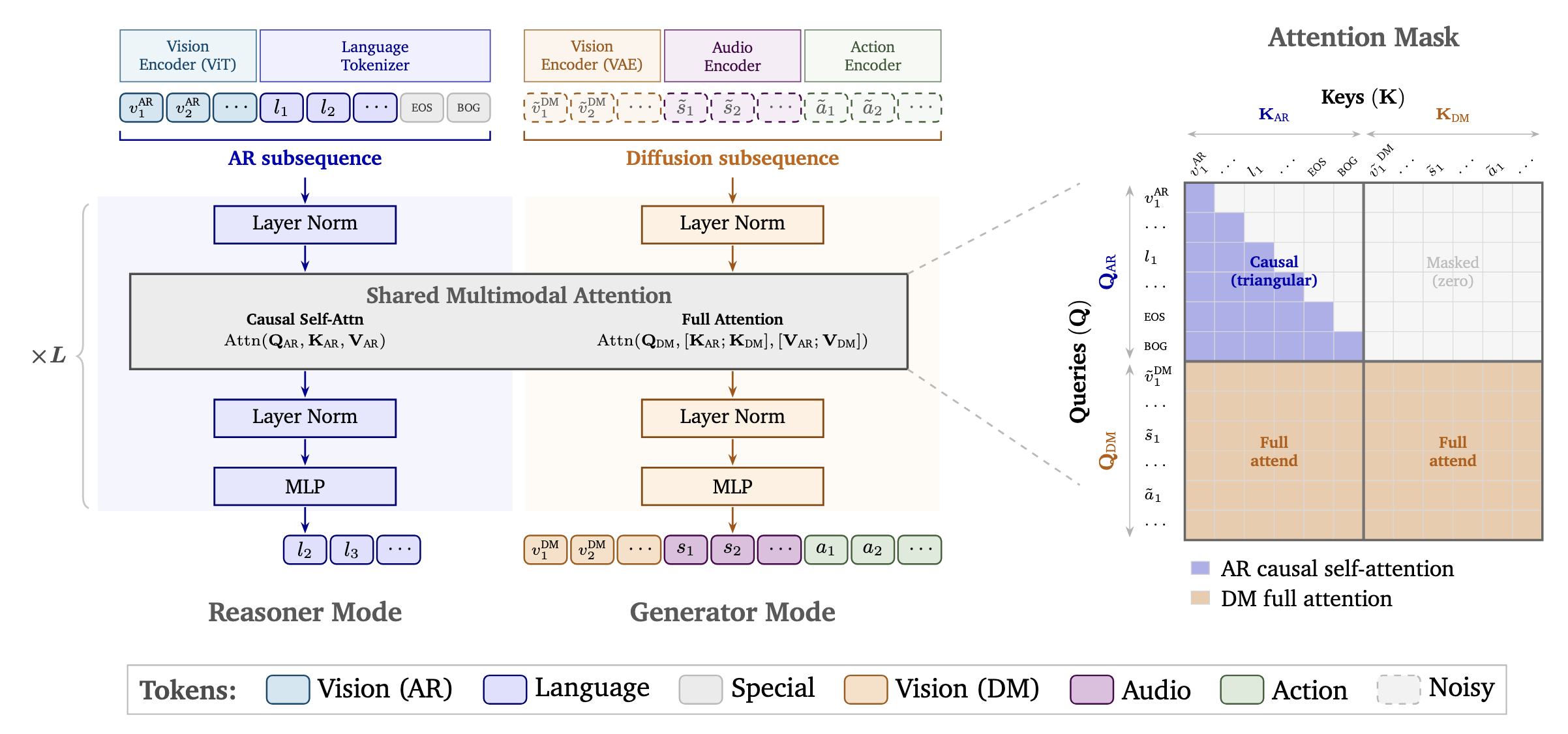
Cosmos 3 appears to use a unified Mixture-of-Transformers (MoT) design combining an autoregressive transformer (Reasoner mode) with a diffusion transformer (Generator mode). Both modes likely share transformer blocks, multimodal attention layers, and a 3D multi-dimensional rotary position embedding (mRoPE). Model sizes are 16B (Nano) and 64B (Super). Integration paths include Hugging Face Diffusers, Transformers, vLLM-Omni, and vLLM for OpenAI-compatible serving. The codebase appears to be primarily Jupyter Notebook-heavy, suggesting research/demo-oriented entry points rather than a production library.
not documented in README
Last push recorded on 2026-06-27 (current date), indicating active ongoing development. The README is comprehensive and versioned, covering Cosmos 3 as the current model family with a clear ecosystem section, troubleshooting, and benchmarks. Maintenance appears to be driven by NVIDIA engineering teams on a continuous basis, not volunteer effort.
ADOPT IF: you are building Physical AI pipelines (robotics, AV, smart infrastructure) and need large-scale generative world models for synthetic training data, policy learning, or sim-to-real transfer, and you have access to the NVIDIA GPU infrastructure required to run 16B–64B parameter models. AVOID IF: you need a lightweight, hardware-agnostic simulation tool, you lack multi-GPU NVIDIA infrastructure, or your use case is standard NLP/CV without physical world modeling requirements. MONITOR IF: you are a researcher in embodied AI or autonomous systems who wants to track how omnimodal world models evolve for downstream policy training, but are not yet ready to commit GPU resources to inference or fine-tuning.
Independent dimensions
Mainstream potential
5/10
Technical importance
9/10
Adoption evidence
3/10
- Hardware lock-in: models are designed for NVIDIA CUDA infrastructure; portability to non-NVIDIA hardware is not documented and likely limited.
- Model scale barrier: the smallest model (Cosmos3-Nano) is 16B parameters, creating significant compute cost for experimentation and inference, limiting accessibility for smaller teams.
- License ambiguity: license is listed as NOASSERTION, which means the actual terms are unclear from metadata alone; users must review the full license before commercial or research deployment.
- Ecosystem dependency: production paths (NIM, vLLM-Omni) tie users to NVIDIA's serving stack, which may create vendor dependency over time.
- Community breadth: activity appears primarily driven by NVIDIA internally rather than a broad open-source contributor base, which may limit community-driven extensions, bug fixes, and independent validation.
Cosmos will likely remain a reference platform for Physical AI world model research, with adoption concentrated in NVIDIA partner programs and well-resourced robotics/AV labs. Broader community uptake may depend on smaller distilled model releases and clearer licensing.
Newsletter
Get analyses like this every Monday
Free weekly digest of the most interesting open-source discoveries.
Languages
Information
- Language
- Jupyter Notebook
- License
- NOASSERTION
- Last updated
- 8h ago
- Created
- 19mo ago
- Analyzed with
- anthropic/claude-haiku-4-5
Stars over time
Contributors over time
Top 100 contributors only — repos with more will plateau at 100.
Open issues
Question about reproducing DROID `droid_lerobot_example` FD in Cosmos3 cookbook
Reproduce of mvbench
Poor video quality when using I2V or V2V with world-scenario-map control in Transfer
QA: what is the action meaning of agibotworld?
Top contributors
Recent releases
Similar repos

Genesis-Embodied-AI/genesis-world
Genesis World is a simulation platform for robotics and embodied AI research...

NVIDIA-NeMo/Nemotron
Nemotron is NVIDIA's developer hub for training, fine-tuning, and deploying the...
| Repository | Stars | Week Δ | Language | Score | Updated |
|---|---|---|---|---|---|
|
NVIDIA/cosmos
this
|
11k | +325 | Jupyter Notebook | 8/10 | 8h ago |
 isaac-sim/IsaacSim isaac-sim/IsaacSim
|
3.6k | — | Python | 8/10 | 1w ago |
|
Genesis-Embodied-AI/genesis-world
|
29.5k | — | Python | 8/10 | 7h ago |
|
NVIDIA/physicsnemo
|
3k | — | Python | 8/10 | 10h ago |
|
NVIDIA-NeMo/Nemotron
|
1.7k | — | Jupyter Notebook | 8/10 | 2d ago |
 Tencent-Hunyuan/HY-World-2.0 Tencent-Hunyuan/HY-World-2.0
|
2.3k | — | Python | 8/10 | 1mo ago |
Genesis has nearly 3x more stars (29k vs 10.6k) and focuses on physics simulation for embodied AI rather than generative world models. It targets a partially overlapping audience but solves a different core problem — deterministic physics sim vs. learned neural world simulation. The two can be complementary.
Also from NVIDIA, IsaacSim is a physics-based robotics simulator using rendering engines. Cosmos targets learned generative simulation and synthetic data, while IsaacSim is deterministic and CAD-grounded. They are likely intended as complementary tools within NVIDIA's Physical AI stack.
HY-World-2.0 is a direct competitor in the open-source world model space with ~2.3k stars. Cosmos has significantly higher visibility and broader modality coverage (audio, action), but HY-World benefits from Tencent's distribution ecosystem in Asia-Pacific markets.
Nemotron focuses on language model training and synthetic data for NLP tasks. Cosmos overlaps in synthetic data generation but specializes in physical, multimodal, and video-grounded scenarios. Both are NVIDIA-maintained and likely intended for distinct pipeline stages.
PhysicsNeMo targets physics-informed neural operators for scientific simulation (CFD, weather). Cosmos targets generative world simulation for robotics/AV. Different problem domains under the Physical AI umbrella, minimal direct overlap.